Sydney’s terraces and older homes are some of the city’s most loved houses. Many are heritage items or sit inside a heritage conservation area, which affects what you can change, how repairs should be done and which approvals you need.
Two NSW Government restoration projects announced in October 2026 are a useful reminder of how careful heritage work is approached. This article draws on them, and on council guidance, to set out what homeowners should think about before renovating.
What has happened
On 22 October 2026 the NSW Department of Planning, Housing and Infrastructure announced two heritage projects in Western Sydney.
At Cecil Hills Farm, listed on the State Heritage Register, a $1.5 million restoration is being delivered in two stages. The first stage, on the homestead, covered roof, weatherboard and window repairs and repainting in colours matched to the original paint. The second stage, on the historic outbuildings, uses specialist heritage tradespeople and traditional techniques, including hand-split ironbark and soft lime mortar.
The government also said Bonnyrigg House, built in 1826 and also on the State Heritage Register, will stay in public hands and be restored, with conservation works to reverse unsympathetic alterations while meeting current building standards.
Neither project involves BND Custom Homes. They are mentioned here only as examples.
What it means for a home renovation
Most Sydney homeowners will never restore a colonial homestead, but the same principles apply to a Victorian terrace or a Federation cottage.
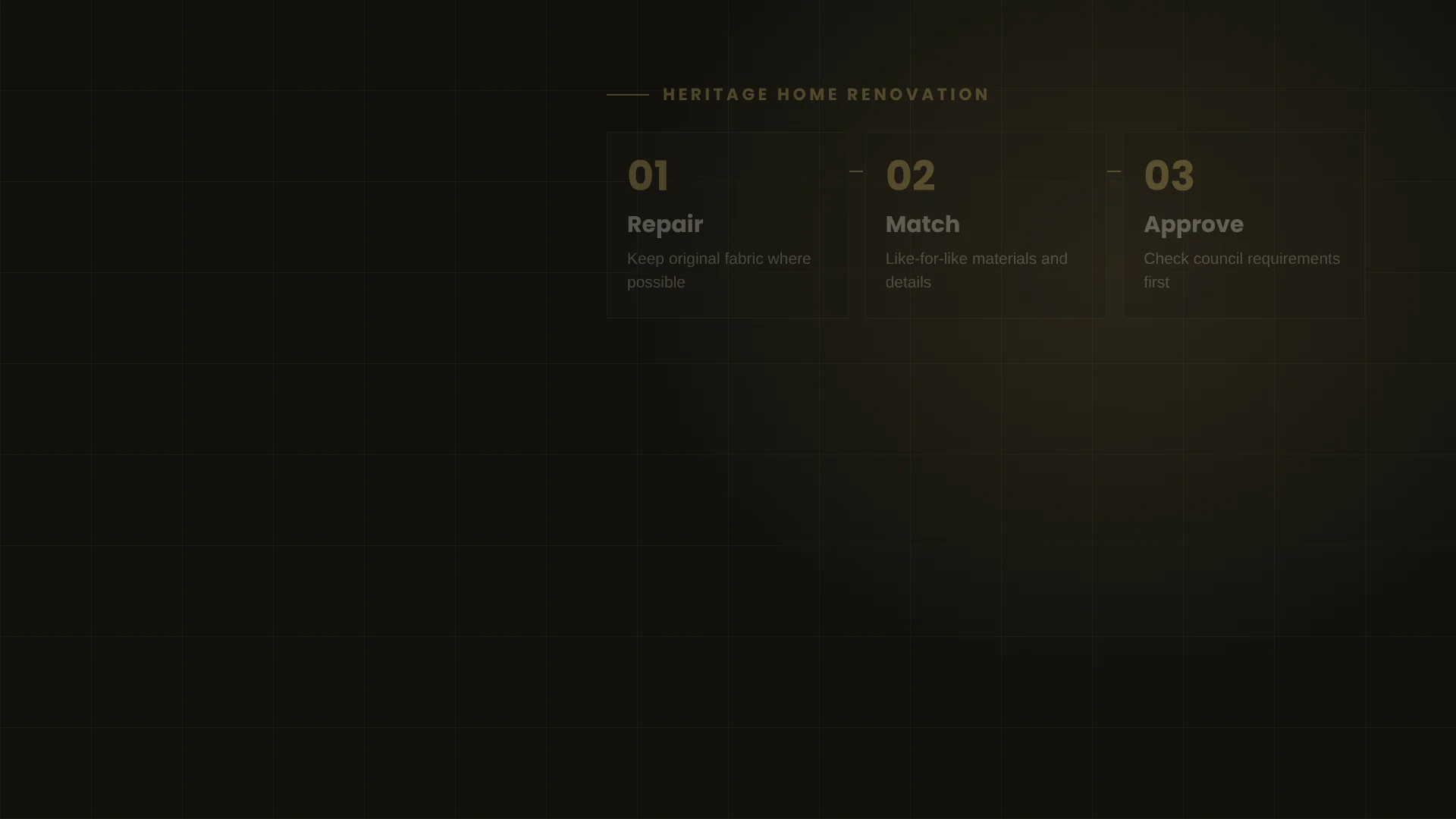
Repair before you replace. Councils generally encourage keeping original fabric. Randwick City Council’s guidance, for example, says repointing lost mortar in brick joints is a better solution than rendering or painting, and that original face brickwork should not be rendered or painted.
Match what is there. Like-for-like means using materials, profiles and details that match the original, such as gutters and downpipes in the original pattern or repainting in heritage colours. The Cecil Hills Farm works show the same approach on a larger scale, from matched paint colours to traditional lime mortar.
Small works may not need a DA, but they may still need council sign-off. The City of Sydney says certain minor or maintenance works on heritage items or in heritage conservation areas can go ahead without a development application, but only if council has been notified and has approved them in writing. Its examples include like-for-like repair of a faulty window, replacing rusty gutters and downpipes to match original details, and restoring a front verandah. Randwick has a similar process and charges an assessment fee.
Bigger changes follow a different path. Extensions, major alterations and demolition generally need a development application. Randwick, for example, asks for a heritage impact assessment by a heritage or conservation architect for major alterations. If a home is on the State Heritage Register, separate approval under the Heritage Act 1977 may be needed as well as council approval.
What to think about before you start
This is general information, not planning or heritage advice. Before renovating a heritage home, you may find it useful to:
- Check whether your property is a heritage item or in a heritage conservation area. Most councils have an online map or planning certificate that shows this.
- Read your council’s heritage guidance. Rules and fees differ between councils.
- Separate maintenance and like-for-like repairs from alterations and additions, as they usually follow different approval paths.
- Ask for written confirmation from council before starting minor works where your council requires it, and keep it with your property records.
- Engage a heritage consultant or architect early for any extension or major change.
- Choose a builder whose team understands traditional materials and how to integrate modern services and current building standards with original fabric.
How BND Custom Homes can help
BND Custom Homes (NSW Builder Licence 488888C) carries out renovations and extensions and builds terraces and multi-dwelling homes across Sydney. We work with your architect, heritage consultant and certifier so the scope reflects your approvals, and plan the work around existing fabric from the start. Read more about how we build.
Next step
If you own a terrace or older home and are planning a renovation, book a consultation to talk through your property and the approvals it may need. Call 0489 034 567.
Sources
- NSW Department of Planning, Housing and Infrastructure: Colonial farming secrets unearthed as Cecil Hills Farm undergoes restoration (2026-10-22, accessed 2026-10-29)
- NSW Department of Planning, Housing and Infrastructure: Minns Labor Government secures future of 200-year-old Bonnyrigg House (2026-10-22, accessed 2026-10-29)
- City of Sydney: Gain exemption from requiring development consent for heritage works (undated, accessed 2026-10-29)
- Randwick City Council: Looking after your heritage house (2024-12-03, accessed 2026-10-29)
This article is general information only. It is not planning, heritage, legal or building advice. Heritage rules differ between councils and properties. Check your council’s requirements and get advice from a qualified professional before starting work.